Embodied Robotics
Dual-arm planning, benchmarks, and robot coordination.
Personal website
柏英杰
Final-year Honours student in Advanced Computing at The University of Sydney, working where embodied AI, data valuation, and social systems meet.
Dual-arm planning, benchmarks, and robot coordination.
Risk-adjusted evaluation under distribution shift.
How technical systems reshape opportunity and governance.
About
I am a final-year Bachelor of Advanced Computing (Honours) student at The University of Sydney, majoring in Computer Science and Financial Economics, with honours supervision by Dr. Weiming Zhi.
My academic path has moved between China, Australia, and Singapore. Across these settings, I have become increasingly interested in how technical systems are shaped by institutions, incentives, and the people who use them.
Feb 2023 - Nov 2026
Bachelor of Advanced Computing (Honours), majoring in Computer Science and Financial Economics.
Honours supervisor: Dr. Weiming ZhiJun 2026 - Aug 2026
Selected to represent The University of Sydney at the United States Studies Centre at UCLA Summer Sessions.
Sep 2025 - Dec 2025
Exchange student supported by the Vice-Chancellor's Global Mobility Scholarship, studying robotics, financial economics, game theory, and machine learning for data mining.
See related research experienceJun 2021 - Nov 2022
Completed foundation studies in science in Wuxi, China, before beginning undergraduate study in Australia.
Research
I am interested in the structural links between intelligent systems and real-world dynamics. Rather than treating AI as a self-contained technical artifact, I look at how models, robots, data, incentives, and institutions interact once technology becomes part of everyday production and decision-making.
This agenda currently takes two forms: technical work on robotics, planning, and robust machine learning; and broader inquiry into how AI and automation reshape productivity, labor structures, public governance, and the distribution of knowledge and opportunity.
Planning complex tasks for dual-arm and multi-arm robots, with interest in LLM-assisted task planning, embodied execution, robot benchmarks, coordination, and control in dynamic environments.
Studying how data, distribution shift, and risk-aware selection affect model behavior, including data valuation frameworks inspired by financial economics.
Exploring how AI and automation, as general-purpose technologies, reshape productivity, labor structures, the global economy, and access to opportunity.
Research Experience
Working with Chenrui Tie on complex dual-arm task planning and execution, and with Chongkai Gao on benchmarks for evaluating robotic manipulation systems.
This work connects high-level language reasoning with embodied action: how a robot decomposes goals, coordinates arms, executes long-horizon tasks, and remains reliable when the environment changes.
Built a fully localized deployment for a domain-specific energy AI system in collaboration with ENN Group, including local LLM inference, databases, multiple RAG frameworks, and an interaction interface.
The project gave me hands-on experience with domain knowledge retrieval, prompt grounding, private deployment, and evaluation for practical LLM systems beyond general-purpose chat settings.
Worked with Dr. Ziheng Meng using open satellite imagery, public datasets, and machine learning to study relationships between under-five child health, mortality, environment, medical infrastructure, and regional health disparities in Africa.
This experience shaped my interest in using large-scale data and computational methods to inform public policy, especially where inequality is difficult to observe directly.
Projects
2026
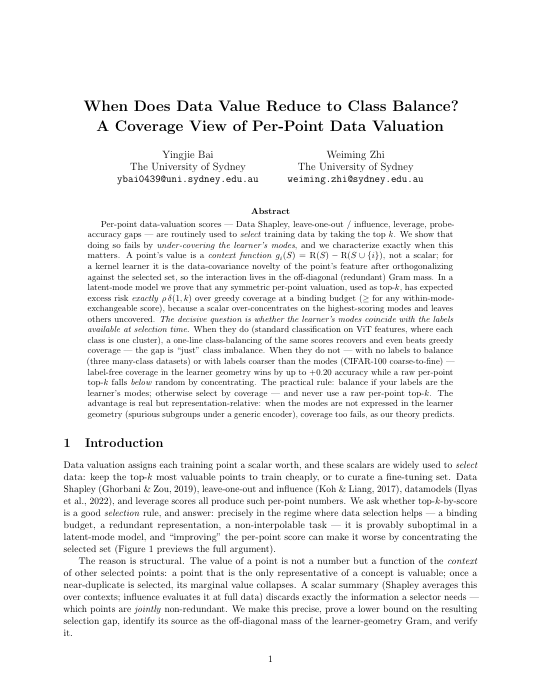
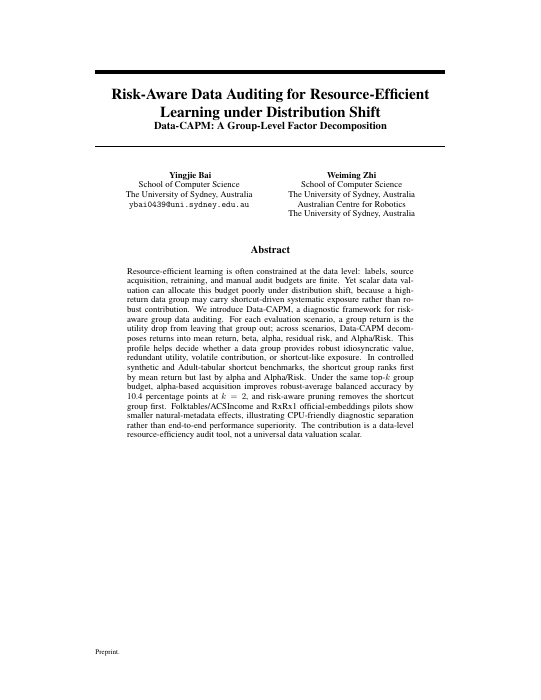
First-author work with Weiming Zhi. Data-CAPM is a diagnostic factor decomposition framework inspired by the Capital Asset Pricing Model, designed for group data valuation under distribution shift.
Instead of compressing data value into a single score, it decomposes group-level return vectors into mean return, beta systematic exposure, alpha idiosyncratic contribution, residual risk, and Alpha/Risk.
What began as a technical question about data valuation became, for me, a broader question about evaluation itself: whether a metric is measuring value, or simply measuring adaptation to the current environment.
I now see evaluation systems as environments too. A score can be useful, but it should also reveal its assumptions, risks, blind spots, and the conditions under which its judgment holds.
Research reflection
I do not oppose evaluation. Without evaluation, societies cannot allocate resources and organizations cannot make decisions. But I increasingly believe that responsible evaluation should not only produce a score or ranking; it should also explain the environment in which that judgment is valid, the assumptions it depends on, what it rewards, what it ignores, and whether it identifies long-term value or merely short-term effectiveness within the current system.
This is the most important thought the paper left me with: evaluation systems are themselves environments. When a person is evaluated, they are not revealing value in a vacuum; they are being observed through a particular set of rules, resources, languages, and metrics.
Some people may appear more valuable because they learned earlier how to speak the system's preferred language, while others may have potential that current metrics cannot capture. Low scores do not always mean low value, and high scores do not always mean robust contribution.
My hope for future AI and robotics is cautiously optimistic: if technology can take over more repetitive, inefficient, and low-meaning work, perhaps people will have more room to explore different paths instead of being fixed too early by a single metric. In machine learning terms, I hope technology can expand each person's search space.
Manuscript in preparation for CoRL 2026 submission
A portfolio-theoretic framework for robot imitation learning, modeling demonstrations as assets with risk, diversity, and cost.
The method proposes a risk-aware data selection objective that improves robustness and transfer across manipulation tasks.
Robotics
Projects include market-inspired pricing mechanisms for shared spatiotemporal resources and a task organization system integrating LLMs, PDDL planning, and agent frameworks.
I am especially interested in whether ideas from economics, such as pricing and resource allocation, can help decentralized robots negotiate congestion and shared constraints.
My intuition is that multi-arm coordination in constrained space is partly a resource allocation problem: each region of space has time-dependent scarcity, and price can act as both a coordination tool and an information signal.
Planning
Developed a robotic task organization system integrating large language models, PDDL planning, and agent frameworks to study multi-robot coordination and complex task planning.
Financial ML
Developed predictive models using GNN and CatBoost with engineered financial and online behavioral features to estimate loan levels.
Data Analysis
Analyzed open transport data for the Sydney Light Rail using R for time-series modeling and visualization, studying passenger-flow dynamics and implications for congestion management.
Independent Project
I initiated Lumen Agora as an open-source, non-profit academic platform for concise research discovery, verified academic identity, and community-driven knowledge exchange.
The project responds to a problem in fast-moving fields such as AI and robotics: there are too many important papers for most people to read in full, yet ideas still need to travel across disciplines.
A "Xiaohongshu + LinkedIn" inspired model: concise summaries help key ideas and results travel quickly, while original papers and authors remain the source of depth and credit.
The platform aims to increase author visibility, support cross-field discussion, and create a better channel between opportunity providers and students or early researchers.
A six-person early team is exploring software, cybersecurity, and outreach while collecting feedback from researchers and faculty across fields.
Leadership
2025
Engaged in discussions on AI governance and robotics with former Singaporean Prime Minister Lee Hsien Loong.
2024 - 2025
Organized English Corner events and coordinated with public institutions and media for cultural outreach.
Feb 2023
Discussed implications of China's rise for Australia's foreign policy with former Australian Foreign Minister Bob Carr.
Selected
Selected for Tsinghua-TUM Winter School, SJTU International Student Development Program, and Google technology forums.
Skills & Interests
Python, C, Java, R, Git, Linux, machine learning, econometrics, and data analysis.
Multi-agent systems, robotics, AI systems, RAG systems, planning, and simulation.
Fencing, kayaking, international travel, game theory, philosophy of algorithms, technology and society.
Contact
For research, collaboration, or a quick hello, email is the best place to start.